It's Not Just a Drug Change: Why the New Stroke Guidelines Are Really About Saving Time, Not Just Brain Cells
Introduction: The Quiet Revolution in the ED
In the breathless choreography of a Code Stroke, the air in the Emergency Department thickens with a singular urgency: time is brain. For decades, this high-stakes race has been dictated by a specific pharmacotherapy and the cumbersome hardware required to deliver it. But a quiet revolution is underway. The 2026 AHA/ASA guideline update has arrived not as a mere clinical tweak, but as a fundamental shift in hospital mechanics.
While the clinical outcomes between the old standard and the new alternative are largely equivalent, health systems are currently tearing up their protocols to make the switch. This raises a compelling question: why would a hospital overhaul its entire stroke pathway for a drug that isn't "better" in the traditional sense? The answer lies in the removal of operational friction. This isn't just a pharmacy update; it's a systematic pruning of failure points.
The 2026 Pivot: Tenecteplase is Now a First-Line Standard
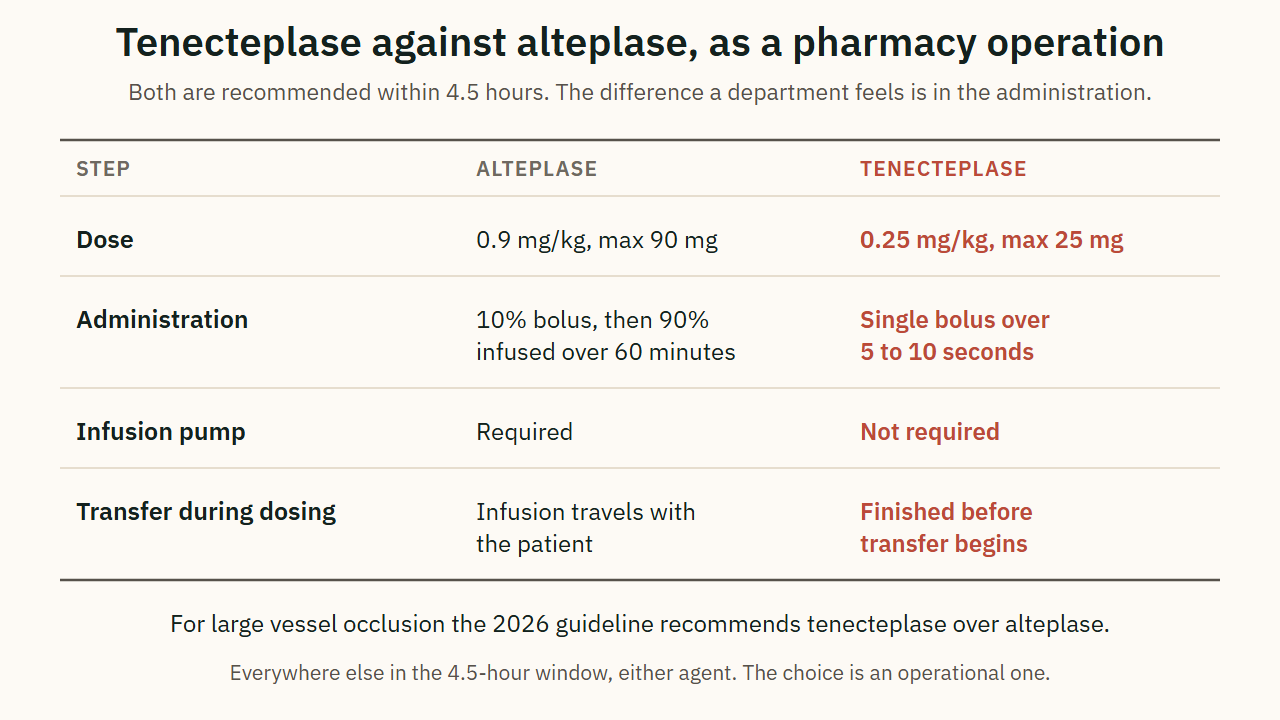
The 2026 AHA/ASA guidelines have officially elevated Tenecteplase (TNK) to a first-line standard, endorsing it alongside Alteplase for use within the critical 4.5-hour thrombolytic window. For the general stroke population, TNK is now recognized as a safe and effective alternative. However, the guidelines highlight one specific clinical arena where TNK takes the lead: Large Vessel Occlusion (LVO). In these high-severity cases, Tenecteplase 0.25 mg/kg is now explicitly recommended over Alteplase.
Beyond the LVO subset, the trials supporting this shift were designed around "noninferiority." In statistical terms, the primary evidence suggests that TNK is simply not meaningfully worse than the previous standard. When clinical outcomes are a wash, the strategist must look elsewhere for value. The real story of the 2026 update is found in the workflow, not the molecule.
"Tenecteplase 0.25 mg/kg to a maximum of 25 mg, as a single intravenous bolus over 5 to 10 seconds, is recommended as a safe and effective alternative to alteplase for eligible patients presenting within 4.5 hours.", 2026 AHA/ASA Guideline
Killing the Pump: The End of the 60-Minute Anchor
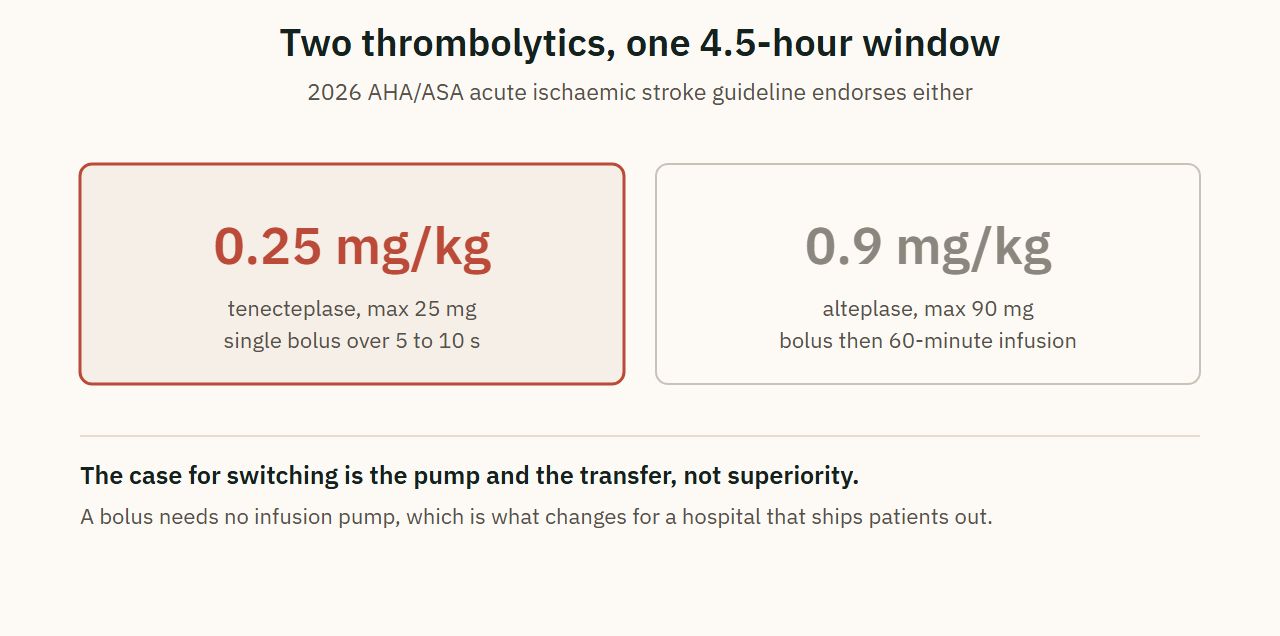
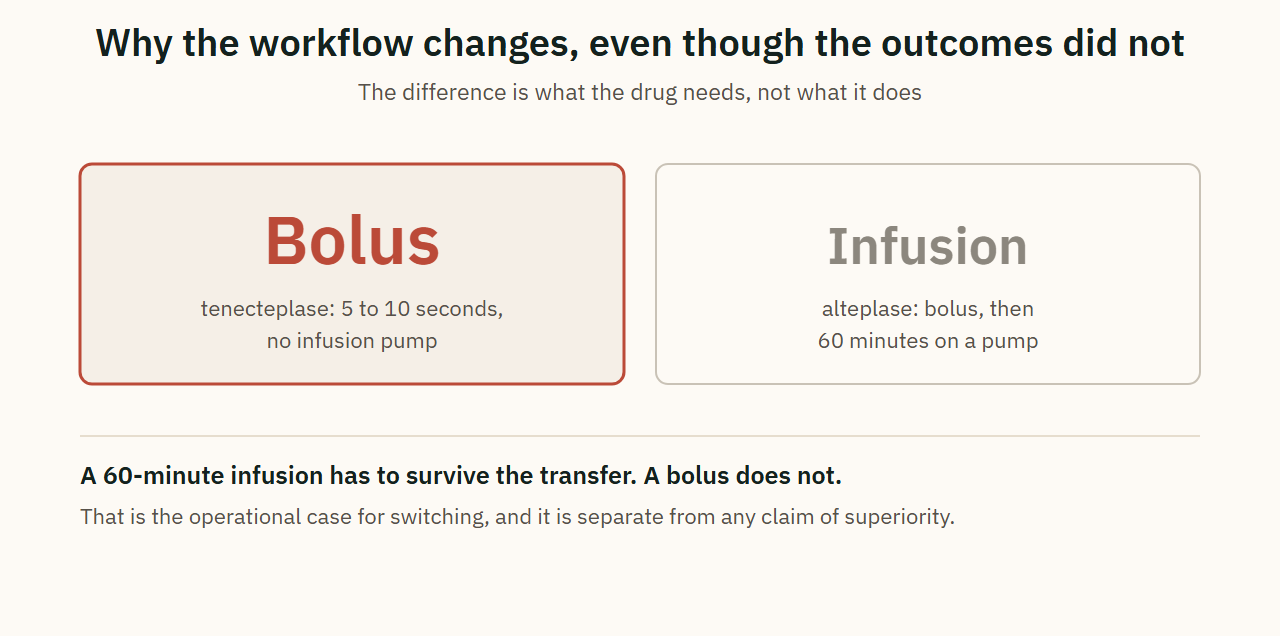
The most transformative difference between these agents is the method of delivery. Alteplase requires a weight-based dose (0.9 mg/kg to a maximum of 90 mg), delivered as a 10% initial bolus followed by a 60-minute infusion. Tenecteplase, conversely, is administered as a single weight-based bolus over just 5 to 10 seconds, with a much lower maximum cap of 25 mg.
Takeaway: The infusion pump disappears from the stroke pathway.
The operational wins here are twofold. First, the hospital eliminates the "60-minute anchor," freeing up the infusion pump and removing the need for continuous device monitoring. Second, the switch significantly reduces preparation efficiency. There are fewer steps between the physician's order and the drug entering the patient's vein, a critical advantage at the exact moment where minutes determine the patient's long-term disability. By removing programming steps and rate-calculation requirements, the hospital essentially deletes the most common sources of administration error.
Treatment Before Transit: Solving the "Spoke-to-Hub" Logistics
For "spoke" hospitals, community facilities that stabilize patients before transferring them to a comprehensive "hub" for thrombectomy, the switch to Tenecteplase solves a perennial logistical nightmare.
Under the Alteplase protocol, patients are frequently loaded into ambulances while the 60-minute infusion is still running. This forces transport teams to manage a high-alert drug in a moving vehicle across organizational boundaries. With Tenecteplase, the treatment is finished before the transfer even starts. By ensuring the drug is fully administered before the patient leaves the facility, hospitals remove the complexity of managing a running infusion during transit, making this perhaps the most powerful argument for adoption in rural and network settings.
Dosing: The Dangerous "Double-Edged" Molecule
While Tenecteplase simplifies the delivery, it introduces a high-stakes dosing paradox. The stroke dose (0.25 mg/kg, max 25 mg) is significantly different from the dosing used for myocardial infarction (MI). This is a stark contrast to Alteplase's 90 mg maximum.
The switch successfully eliminates the "residual-dose problem", the risk of error when handling the volume remaining in an Alteplase bag after the initial bolus. However, it replaces that risk with the danger of indication confusion. Because the stroke dose is typically much smaller than the MI dose, the operational challenge shifts to the pharmacy and IT departments.
"This is the highest-risk element of the entire switch. Two indications, one molecule, different doses, and the stroke dose is the smaller one. Whatever your order set does, it should make the myocardial infarction dose unreachable from the stroke pathway.", Source Analysis
The "Clean Cutover" vs. The Learning Curve
Transitioning a hospital to TNK requires more than a formulary update; it requires a tactical deployment plan involving order set automation, stocking kits in automated dispensing cabinets, and nursing competency training for the 10-second bolus technique.
Administrators must also manage expectations. It is vital to realize that this switch is not a "silver bullet" for stroke complexity. The "Reality Check" is that the 2026 guidelines change nothing regarding patient eligibility, the 4.5-hour window, blood pressure parameters, or the necessity of bleeding risk conversations.
Furthermore, leadership must decide on the "cutover" strategy. While keeping both drugs in stock might feel like a safety net, it actually creates a "look-alike" selection risk during the high-pressure environment of a Code Stroke. A "clean cutover", removing Alteplase entirely and replacing it with TNK overnight, is often the safer strategic move, despite the initial friction of a sudden change.
Conclusion: A Workflow Decision in Disguise
The 2026 guideline update is a rare moment in clinical medicine where the method is more important than the molecule. Tenecteplase is a workflow decision in disguise. By adopting a single bolus, hospitals can dismantle failure points like infusion pumps, streamline high-risk transfers, and accelerate preparation times.
Ultimately, while the drug is new, the mission remains identical. This leads to a final, vital question for healthcare leadership: Is your current stroke pathway designed to accommodate the limitations of a drug, or is it truly optimized for the patient's speed of care?
Related
- The 2026 AHA/ASA acute ischemic stroke guideline
- UIC Drug Information Group on the 2026 stroke pharmacotherapy updates
- How to read the statistics in a clinical trial, on noninferiority
- Andexanet alfa is off the US market, the other emergency-drug change this year
- Running the Clinical Program, on managing a formulary conversion without a look-alike error
Want the practice knowledge behind this?
Your First Year as a Hospital Pharmacist covers the clinical judgment a residency front-loads. Part of the Pharmacy Handoff library.
See the book