The 22-Year Mistake: Why the FDA Just Rewrote the Rules on Vaginal Estrogen
The Hook: A Ghost in the Pharmacy
For over two decades, a clinical "ghost" has haunted the pharmacy counter. Since 2003, every prescription for vaginal estrogen has carried a heavy psychological and clinical burden: the "Black Box" warning. Derived from data on systemic oral hormones, these prominent boxed warnings cautioned patients and clinicians about severe risks like stroke and breast cancer, even for local creams with almost no systemic absorption.
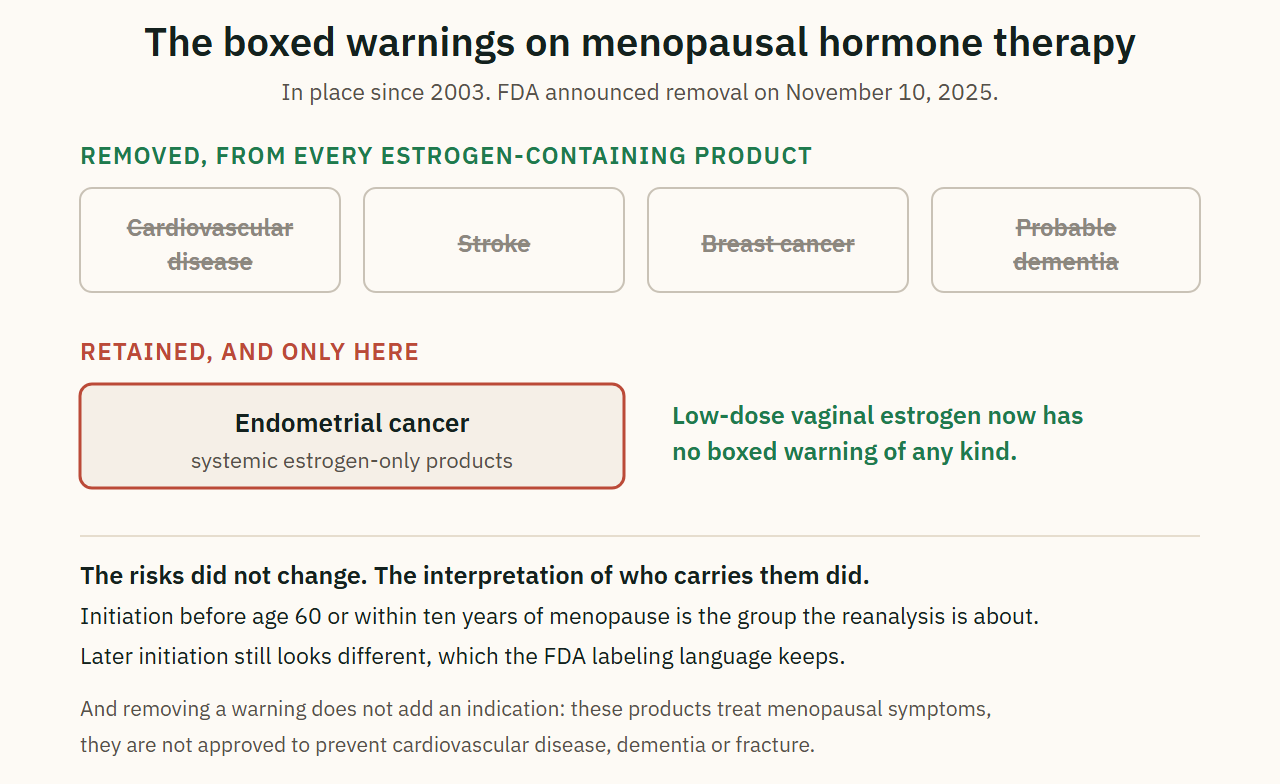
This mismatch between the label and clinical reality created a persistent barrier. Patients often declined highly effective local treatments after reading the alarming inserts, and clinicians hesitated to prescribe them, despite proven benefits. On November 10, 2025, that landscape fundamentally changed. The FDA officially removed four major boxed warnings, finally aligning the product labels with decades of refined, evidence-based medicine.
What is not settled
The label wording itself was not read for this piece. Two independent secondary reports agree on the date, the four warnings, the scope and the retained endometrial warning. For any specific product, read the current label.
The underlying reanalysis is summarized, not examined. The hazard ratio of 0.94 comes from the stated basis for the FDA action. What a hazard ratio near 1 with an unstated confidence interval does and does not establish is a separate question, and the interval was not located.
Systemic hormone therapy is a broader and more contested subject than the vaginal estrogen question, and this piece deliberately does the narrow one.
Takeaway 1: Four Warnings Are Gone (But One Remains)
The FDA's action was comprehensive, affecting every estrogen-containing menopausal hormone therapy (MHT) product, ranging from high-dose systemic pills to low-dose vaginal creams and rings.
The following four warnings have been removed from the boxed section of these labels:
-
Cardiovascular disease
-
Stroke
-
Breast cancer
-
Probable dementia
It is critical for pharmacists to note that one warning remains: the boxed warning for endometrial cancer. This specific warning is retained on hormone therapy products containing systemic estrogen alone (without a progestogen).
The scope of this change is massive. By stripping these warnings from low-dose vaginal products, the FDA has acknowledged that the "class-wide" approach to hormone safety was an overgeneralization that ignored the pharmacokinetics of local delivery.
Takeaway 2: The "Timing Hypothesis" Changes Everything
The reversal was not arbitrary; it was driven by the extended follow-up of the Women's Health Initiative (WHI). The original 2003 warnings were based on a study population that skewed older and many years past the onset of menopause.
Modern analysis has validated the "Timing Hypothesis," which posits that the risk profile of hormone therapy is significantly influenced by the patient's age and proximity to menopause onset. For women who start therapy early, the statistical reality is far more reassuring than the previous labels suggested.
Takeaway 3: The Biggest Win for the Smallest Dose
While the label change affects systemic therapy, low-dose vaginal estrogen is the "cleanest case" for this update. These products have negligible systemic absorption; the hormones stay localized rather than circulating throughout the body.
For twenty-two years, these products "inherited" their warnings by class rather than earning them by evidence. While systemic pills were linked to higher risks in certain populations, a Cochrane meta-analysis confirmed that low-dose vaginal estrogen shows no increased risk for endometrial or breast cancer. Removing these warnings corrects a long-standing clinical inaccuracy where the "Black Box" on the package was frequently more dangerous to patient care than the drug itself.
Takeaway 4: The Secret Weapon for Antimicrobial Stewardship
As clinical pharmacists and MSLs, the most impactful takeaway is the connection between vaginal estrogen and antimicrobial stewardship. There is a direct, evidence-based link between the use of vaginal estrogen and the prevention of recurrent Urinary Tract Infections (rUTIs) in postmenopausal women.
The AUA/CUA/SUFU guidelines provide a Moderate recommendation (Evidence Grade B) for recommending vaginal estrogen to reduce UTI risk. The removal of the Black Box eliminates the primary psychological barrier to this antibiotic-sparing strategy.
The Stewardship Logic Chain:
-
Non-antibiotic intervention \rightarrow Vaginal estrogen restores the local environment and vaginal microbiome.
-
Reduced UTI recurrence \rightarrow Restoration of healthy flora leads to fewer symptomatic infections.
-
Fewer antibiotic courses \rightarrow Decreased patient exposure to repeated antimicrobial agents.
-
Decreased risk of resistant organisms \rightarrow Fewer opportunities for bacteria to develop resistance (e.g., ESBL-producing organisms).
Takeaway 5: Removing a Warning is Not Adding an Indication
Clinical accuracy requires understanding the limits of this FDA action. While the "scary" labels are gone, the fundamental indications for these medications remain unchanged.
| What | Why it matters |
|---|---|
| Symptoms, not prevention | MHT is approved to treat menopausal symptoms (like vasomotor symptoms or genitourinary syndrome of menopause). It is still not approved for the primary prevention of heart disease, dementia, or fractures. |
| Age still matters | The reanalysis shows that risks remain greater for older women and those who initiate therapy more than ten years after the onset of menopause. |
| Individual assessment | A label change does not replace clinical judgment. Personal and family history, comorbidities, and patient preferences must still guide the conversation. |
The Clinical "To-Do" List: What Pharmacy Techs and Pharmacists Must Do Now
The FDA expected labels to update within six months of the November 2025 announcement. Since we are now well past that window, the "Black Box" is no longer just a ghost, it is a factual error.
| What | Why it matters |
|---|---|
| Audit Patient Handouts | Check your pharmacy's printed monographs and patient education materials immediately. Any handout still featuring the four removed boxed warnings is now clinically and legally outdated. |
| Revisit the rUTI Patient | Identify postmenopausal women currently on rotating antibiotic prophylaxis or multiple acute courses. These patients are prime candidates for a guideline-recommended intervention that is now much easier to counsel. |
| Update the Counseling Script | Inform patients who previously declined therapy due to "stroke or cancer" risks. You can now confidently state that the FDA has removed those warnings for these products based on long-term safety data. |
| Engage the Prescriber | Act as a bridge for clinicians still practicing based on 2003 data. When you see a patient struggling with rUTIs or GSM, provide the evidence of the label change to hesitant prescribers to facilitate better care. |
| Respect Oncology Boundaries | Maintain specialized care for breast cancer survivors. While the general label has changed, the evidence for use in patients with a history of breast cancer remains "nuanced" and requires a direct conversation with the treating oncologist. |
Conclusion: A New Era for Patient Conversations
We have officially moved from an era of "class-wide fear" to an era of "patient-specific evidence." The FDA's decision to remove these warnings allows us to have more honest, data-driven conversations about the actual risks and benefits of therapy.
Now that the FDA has removed the barrier, how many of your patients are still being treated based on a label that no longer exists?
Related
- The Menopause Society on the FDA announcement
- AUA guideline on recurrent uncomplicated UTI in women
- An ESBL urine culture no longer means a carbapenem line
- How to read the statistics in a clinical trial
- Running the Clinical Program, on stewardship interventions that never appear in a stewardship report
Want the practice knowledge behind this?
Your First Year as a Hospital Pharmacist covers the clinical judgment a residency front-loads. Part of the Pharmacy Handoff library.
See the book