The end of the mandatory IV: what the 2026 ESBL guidance changes at discharge
Introduction: The Culture Result that Used to Mean a Hospital Stay
It is a scenario every clinician and pharmacist knows well: a patient is clinically improving, symptoms are resolving, and they are ready for discharge, until the urine culture returns. The screen flashes "ESBL-producing E. coli."
Historically, this result triggered a cascade of logistics. To ensure effective treatment, we were forced to choose between a prolonged hospital stay for intravenous (IV) carbapenems or the placement of an invasive PICC line for outpatient parenteral antibiotic therapy (OPAT). Both options carry significant risks, from hospital-acquired infections to line-associated clots.
The Infectious Diseases Society of America (IDSA) has fundamentally changed this landscape. On July 30, 2026, the IDSA released Version 5.0 of its "Guidance on the Treatment of Antimicrobial-Resistant Gram-Negative Infections." This update marks a watershed moment in stewardship: resistant isolates in the urine no longer automatically mandate an IV-based plan.
What is not settled
The bloodstream infection question is open, not answered. The guidance still prefers a carbapenem and now points to trials in progress.
The new oral agents have thin resistant-organism data. They were studied in uncomplicated UTI populations, not in ESBL cohorts specifically. Their place in the guidance rests on spectrum and on the indication, and the difference between a registrational trial population and the patient in front of you is the thing to hold onto.
Cefiderocol as preferred monotherapy for Stenotrophomonas is stated with limited clinical data acknowledged in the document itself.
Recommendation strengths are not reproduced here because the change summary consulted does not include them. Read the guidance before writing local policy.
Takeaway 1: The New "Preferred" Oral Trio for ESBLs
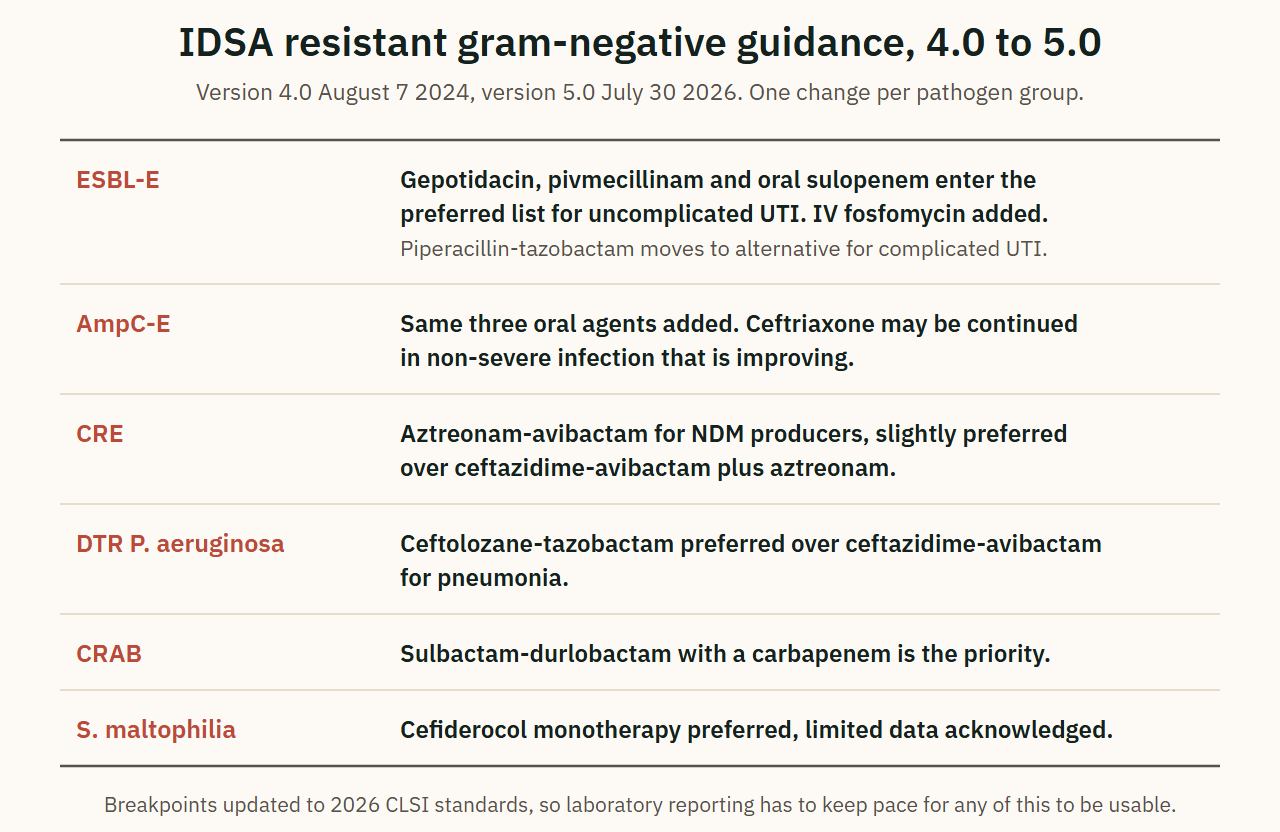
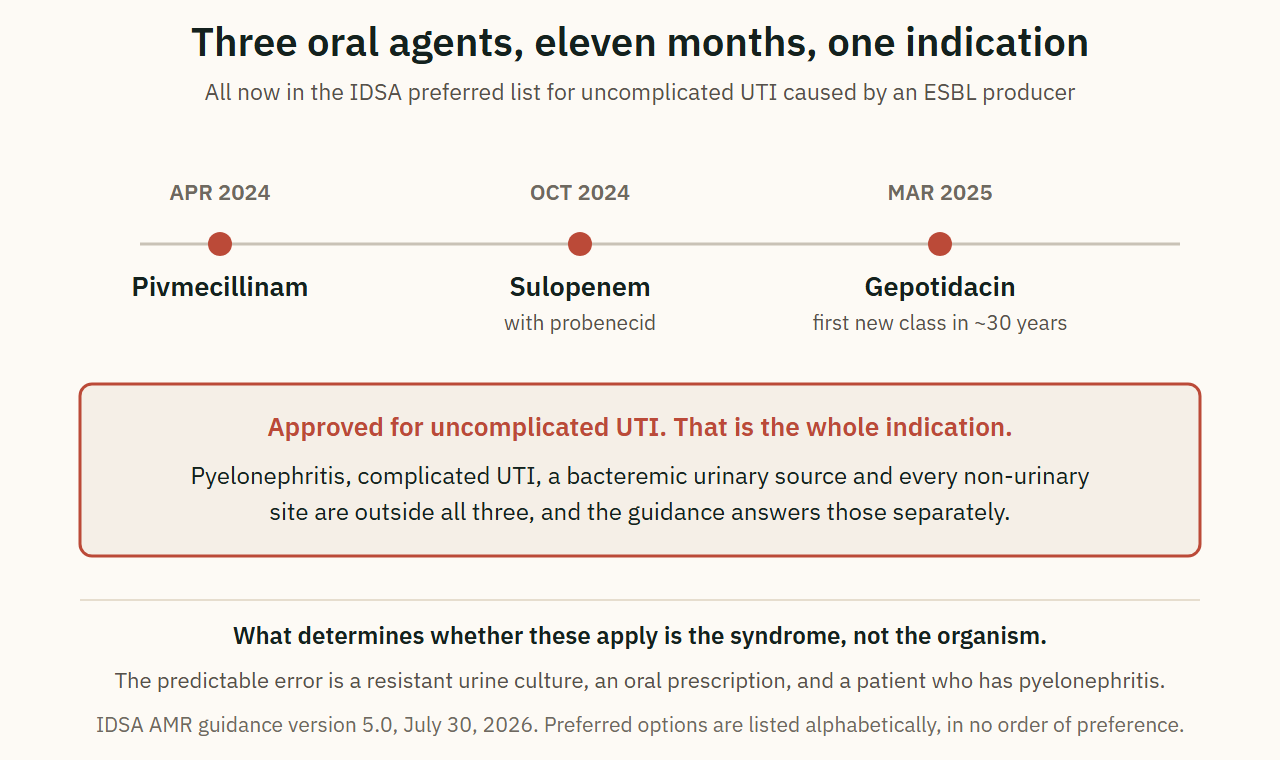
The most impactful shift for the clinical pharmacist is the addition of three new oral agents, gepotidacin, pivmecillinam, and sulopenem, to the "preferred" list for uncomplicated urinary tract infections (UTI) caused by ESBL-producing Enterobacterales.
These drugs, FDA-approved in an eleven-month window between 2024 and 2025, provide a robust alternative to carbapenems. The toolkit for ESBLs has also expanded on the parenteral side with the arrival of intravenous fosfomycin and a defined role for cefepime-enmetazobactam, but for transitions of care, the oral trio is the headline.
| Agent | FDA Approval Date | Approved Indication |
|---|---|---|
| Pivmecillinam | April 2024 | Uncomplicated UTI, adult women |
| Sulopenem etzadroxil with probenecid | October 2024 | Uncomplicated UTI, adult women |
| Gepotidacin | March 25, 2025 | Uncomplicated UTI, women and patients 12+ |
As an MSL, I find the inclusion of gepotidacin particularly compelling. It is the first oral antibiotic in a new class (triazaacenaphthylenes) for this indication in nearly 30 years. Because it utilizes a novel mechanism of action, there is no established cross-resistance with our existing portfolios, a massive win for stewardship.
Takeaway 2: The Syndrome Matters More Than the Bug
While the arrival of these oral options is a breakthrough, the 2026 guidance places a "stewardship fence" around them. These agents are not universal fixes for all ESBL infections; they are strictly for uncomplicated UTI.
Clinicians must distinguish between "uncomplicated UTI" and "complicated UTI/pyelonephritis" before reaching for these scripts. The registrational trials were conducted in uncomplicated populations. Consequently, these drugs are not recommended for pyelonephritis or any non-urinary sites.
The critical "Pharmacist's Warning": If the patient has a bacteremic urinary source, these oral agents are off the table. A positive blood culture fundamentally changes the "syndrome" from a localized bladder infection to a systemic one, where these new oral options lack sufficient data.
The most likely "failure mode" for clinicians will be reacting to a resistant urine culture by prescribing an oral agent without verifying the clinical syndrome. If the patient has a fever, flank pain, or positive blood cultures, we must stick to established systemic therapies.
Takeaway 3: The Piperacillin-Tazobactam "Softening"
The status of Piperacillin-tazobactam (Zosyn) for ESBL infections has been the single most-argued point at stewardship rounds since the MERINO trial was published. The 2026 update provides a nuanced "softening" of the previous stance.
Of note for the lab-minded clinician: the ceftriaxone MIC criterion used in the ESBL discussion has been revised to 4 mcg/mL or above.
| Setting | 2024 (Version 4.0) | 2026 (Version 5.0) |
|---|---|---|
| ESBL Complicated UTI | Not preferred | Alternative |
| ESBL Bloodstream Infection | Carbapenem preferred | Carbapenem preferred (Trials ongoing) |
While Zosyn is now an "alternative" for complicated urinary infections, its use for extra-urinary sites remains discouraged. However, the 2026 update admits the question is "open" by citing ongoing trials for bloodstream infections. This moves the clinical conversation from a firm "no" to "not on current evidence," which is a more honest reflection of the evolving data landscape.
Takeaway 4: The Surprising Permission to De-escalate in AmpC
In a move that challenges the common reflex to escalate therapy when resistance is suspected, Version 5.0 introduces "permission" to de-escalate in the context of AmpC-producing Enterobacterales. This includes the addition of Hafnia alvei as a moderate-risk organism.
The guidance states that continuing ceftriaxone is acceptable in non-severe infections that are showing clinical improvement. For many clinicians, seeing an AmpC producer triggers a reflexive switch to cefepime or a carbapenem. This update provides stewardship teams with the evidence needed to stay the course with narrower therapy in stable patients, provided the clinical trajectory is positive.
Takeaway 5: Precision Strikes for NDM, Pseudomonas, and CRAB
For high-resistance pathogens, the 2026 update moves toward highly specialized "precision" recommendations:
| What | Why it matters |
|---|---|
| NDM Producers | Aztreonam-avibactam has arrived and is now slightly preferred over the previous "workaround" combination of ceftazidime-avibactam plus aztreonam. |
| DTR-Pseudomonas | For pneumonia caused by difficult-to-treat (DTR) Pseudomonas aeruginosa, ceftolozane-tazobactam is now preferred over ceftazidime-avibactam. However, clinicians should note the new warning regarding imipenem-cilastatin-relebactam and the risk of resistance emergence during therapy. |
| Acinetobacter (CRAB) | The guidance clarifies that sulbactam-durlobactam with a carbapenem is the priority approach. While cefiderocol is a preferred monotherapy option for invasive infections, it is often part of a broader strategy. |
| Stenotrophomonas | Cefiderocol monotherapy is now preferred, though the guidance explicitly acknowledges that clinical data remains limited. Aztreonam-avibactam has been moved to an alternative role here. |
Conclusion: Reforming the Discharge Decision
The primary impact of the 2026 IDSA update is the potential to revolutionize transitions of care. Pharmacy and stewardship teams now have the tools to avoid unnecessary IV lines, reduce nursing visits, and mitigate the risks associated with indwelling catheters.
To implement these changes safely, use this Checklist for Clinicians:
| What | Why it matters |
|---|---|
| Review Laboratory Breakpoints | Confirm your microbiology lab is using 2026 CLSI standards. If your lab relies on older breakpoints, your susceptibility reporting and the guidance recommendations will conflict. |
| Check Local Order Sets | Any ESBL pathway or discharge protocol written before August 2026 is now outdated. Ensure the new oral trio is integrated. |
| Establish Formulary Criteria | Since these agents are on-patent, define clear use cases: typically a female patient with an uncomplicated UTI and an organism resistant to first-line options like nitrofurantoin. |
| Verify the Syndrome | Always confirm the infection is an "uncomplicated UTI" (no pyelonephritis, no bacteremia) before utilizing the new oral trio. |
Is your hospital's discharge pathway still operating on 2024 evidence, or are you ready to embrace the oral-first era of 2026?
Related
- IDSA guidance on antimicrobial-resistant gram-negative infections
- The 2026 update, summarized against 2024
- Gepotidacin approval, March 2025
- The 2025 pneumonia guideline made courses shorter
- Two drug shortage counts, 227 and 75, on the antimicrobials in short supply
- Running the Clinical Program, on turning a guidance update into a stewardship intervention
Want the practice knowledge behind this?
Your First Year as a Hospital Pharmacist covers the clinical judgment a residency front-loads. Part of the Pharmacy Handoff library.
See the book