The Pharmacy Automation Myth: Why AI is Already Here (But Not Replacing You)

Pharmacists are scanning the horizon for a 2045 storm while the tide has already risen to their knees in 2026. In professional forums like Student Doctor Network, a persistent anxiety looms over the "great displacement", a theoretical future where technology fundamentally unseats the pharmacist. However, this fixation on a distant, total takeover ignores the current reality: AI has already arrived, but it is not performing the tasks most practitioners fear losing.
The core problem is that pharmacists are braced for a future displacement while missing the nuanced ways AI is currently integrating into their daily workflows.
Adoption is Already Past the Pilot Stage
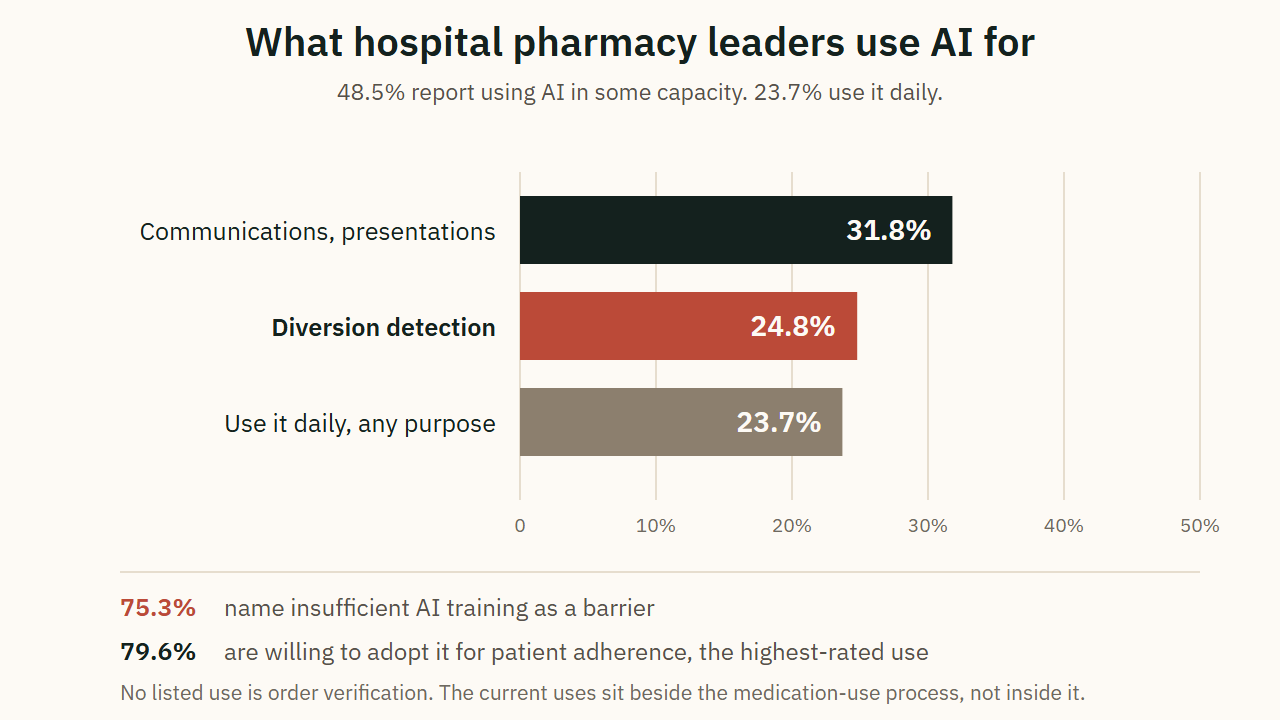
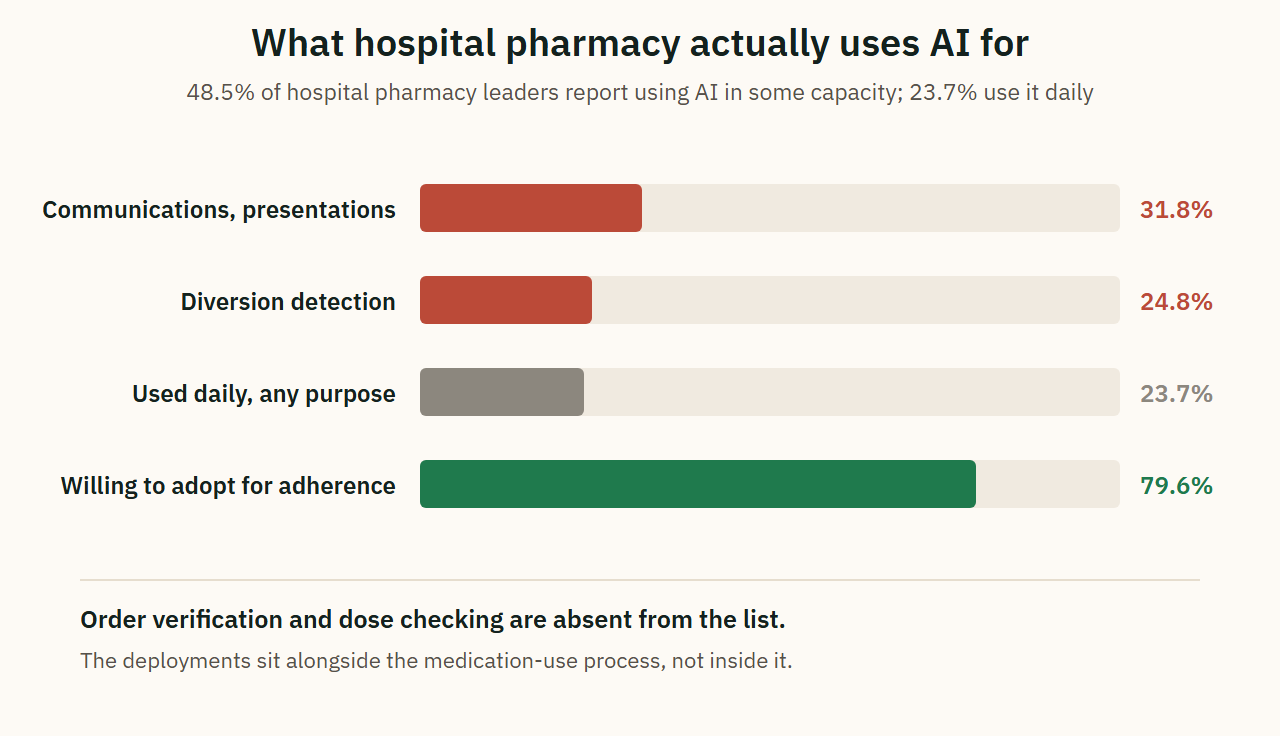
AI is no longer a theoretical "future" technology; it is a workplace reality. Industry reporting from Bluesight indicates that 48.5% of hospital pharmacy leaders are using AI in some capacity, with 23.7% utilizing it on a daily basis. The industry has moved well beyond the pilot stage, yet the displacement predicted by alarmists has failed to materialize.
Crucially, this is because current adoption is designed to work "alongside" the pharmacist rather than "inside" the clinical decision-making process. The most common applications are communications and presentations (31.8%) and diversion detection (24.8%). Even in patient-facing domains, there is a high willingness to adopt AI for low-stakes tasks, such as patient adherence support (79.6%). These figures suggest that AI is currently eating the administrative and monitoring tasks, not the license itself.
The "Often Right" Standard is the Invisible Shield
The primary reason AI has not displaced pharmacists in high-stakes clinical areas is the "determinism" standard. This is the invisible shield protecting the profession. While large language models are excellent at synthesizing data, they operate on a probabilistic basis, they are designed to be "usually right." In pharmacy, "usually" is a clinical failure.
Medication decisions require a shift from systems that provide probable answers to those that provide consistent, deterministic accuracy. Where a wrong answer could reach a patient, the margin for error is non-existent.
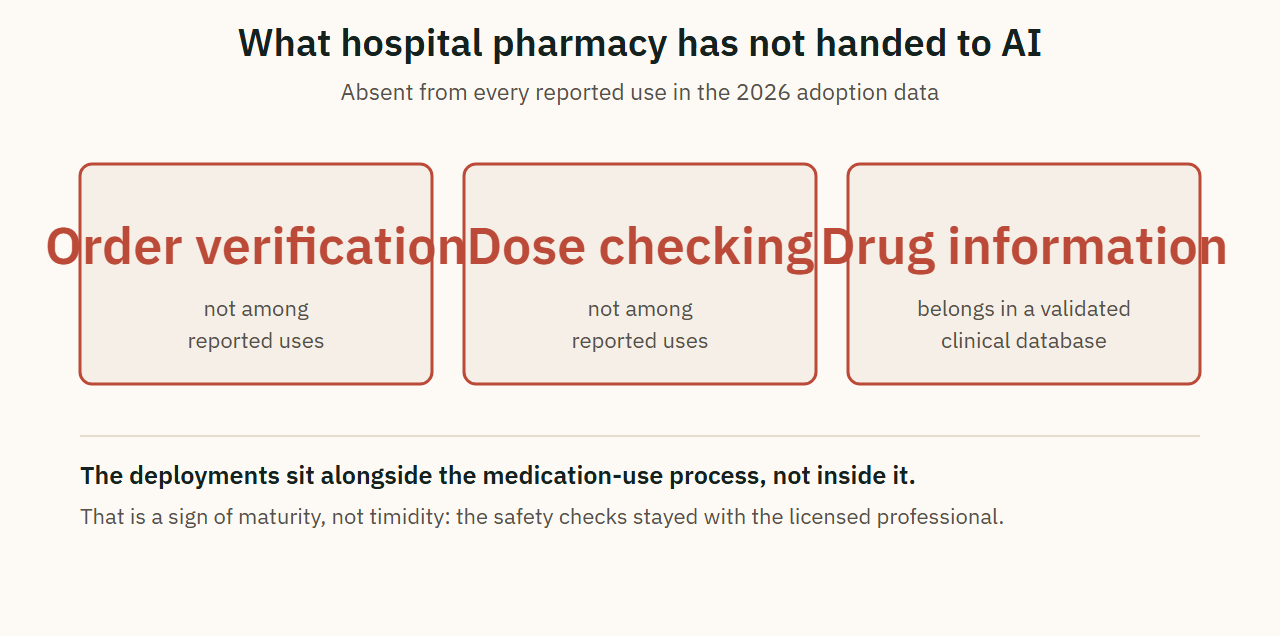
Because of this standard, AI remains a tool for data synthesis and anomaly detection rather than a substitute for final order verification or dose checking.
The Real Barrier is Training, Not Intelligence
The assumption that AI is limited by its own lack of "brain power" is a misunderstanding of the current bottleneck. Peer-reviewed surveys of hospital pharmacists reveal that the most significant barriers to AI adoption, both cited by 75.3% of respondents, are insufficient AI training and concerns regarding patients' emotional wellbeing.
This bottleneck represents a massive opportunity for the profession. The technology's capability is less of a hurdle than the workforce's ability to manage it. The pharmacist who masters these tools becomes the essential "human-in-the-loop," bridging the gap between raw data synthesis and clinical application. If the barrier is training, the pharmacist's future is not determined by the machine's intelligence, but by their own institutional readiness.
Scope Expansion is a Strategic Retreat into Judgment
While the mechanics of dispensing are indeed being automated or delegated, notably through the Pharmacy Technician Certification Board (PTCB) rollout of technician product verification (tech-check-tech), the profession is legislatively moving in the opposite direction.
The legislative trajectory is aggressive: 211 bills across 44 states were introduced in the 2025 session to expand pharmacist scope, a significant jump from 165 bills in 41 states just one year prior. These bills, alongside the ACPE 2025 Standards, are codifying screening, testing, diagnosis, and prescribing into the very fabric of the profession.
This is a strategic retreat into the only domain AI cannot legally or safely touch: clinical judgment. By moving toward "test-and-treat" and independent prescribing, pharmacists are migrating their workload into the category of "deterministic" tasks that require a professional license and human accountability.
The Informatics Blueprint: Diversion Detection
Diversion detection serves as the "Informatics Blueprint" for successful AI integration. Currently the second most common use of AI at 24.8%, it highlights exactly where the technology excels. AI can monitor pattern recognition across massive volumes of dispensing records, a data-heavy task that no human could perform manually with any degree of accuracy.
However, the system remains safe because it triggers a human review rather than a direct patient action. The AI identifies the anomaly; the pharmacist applies the judgment. This model preserves the pharmacist's role as the final authority while using AI to handle the cognitive load of data monitoring that previously went ignored or under-analyzed.
Conclusion: The "Two Buckets" Test
The pharmacy profession is not being erased; it is being redistributed. To understand your own professional exposure to automation, you must apply the "Two Buckets" test to your daily practice:
-
Bucket One (The Probabilistic): Work where a "usually correct" answer is useful. This includes drafting communications, identifying data patterns, and adherence support. AI is rapidly filling this bucket.
-
Bucket Two (The Deterministic): Work where a wrong answer cannot reach a patient. This includes final order verification, complex clinical diagnosis, and prescribing. This bucket is protected by the requirement for deterministic accuracy.
The value of your license is now entirely contained within Bucket Two. As automation and technician delegation handle the distributive tasks of the past, the critical question for every pharmacist is this: In your daily practice, how much of your week is spent on work where "usually correct" isn't good enough, and are you ready for that to become your entire job?
Related
- The original thread on Student Doctor Network
- Hospital pharmacists' attitudes toward AI integration
- What ambient AI documentation did for 41 pharmacists
- How to get into pharmacy informatics from the job you already have
- Running the Pharmacy, on where automation fits in the operations picture
- Running the Clinical Program, on the clinical work the scope expansion points at