Why a 1.5-Minute Time Save Is Winning Over Pharmacists: The Truth About Ambient AI

Imagine a tool that only saves you 86 seconds per visit. Now, imagine that same tool being voluntarily used by 65% of your staff for every eligible encounter.
This is the "86-second paradox" emerging from the first-ever study of ambient AI documentation in clinical pharmacy. For health system leaders and informatics specialists, these results, recently published in AJHP, offer a rare, data-driven look at how artificial intelligence actually functions in the ambulatory clinic. The workload picture behind it is stark: 73% of pharmacists rate their workload as high or excessively high, and they report an average of 8.1 poor mental health days per month.
Against that, raw time saved is the wrong measure. The question is what actually moves clinician well-being.
The 86-Second Paradox (Value vs. Volume)
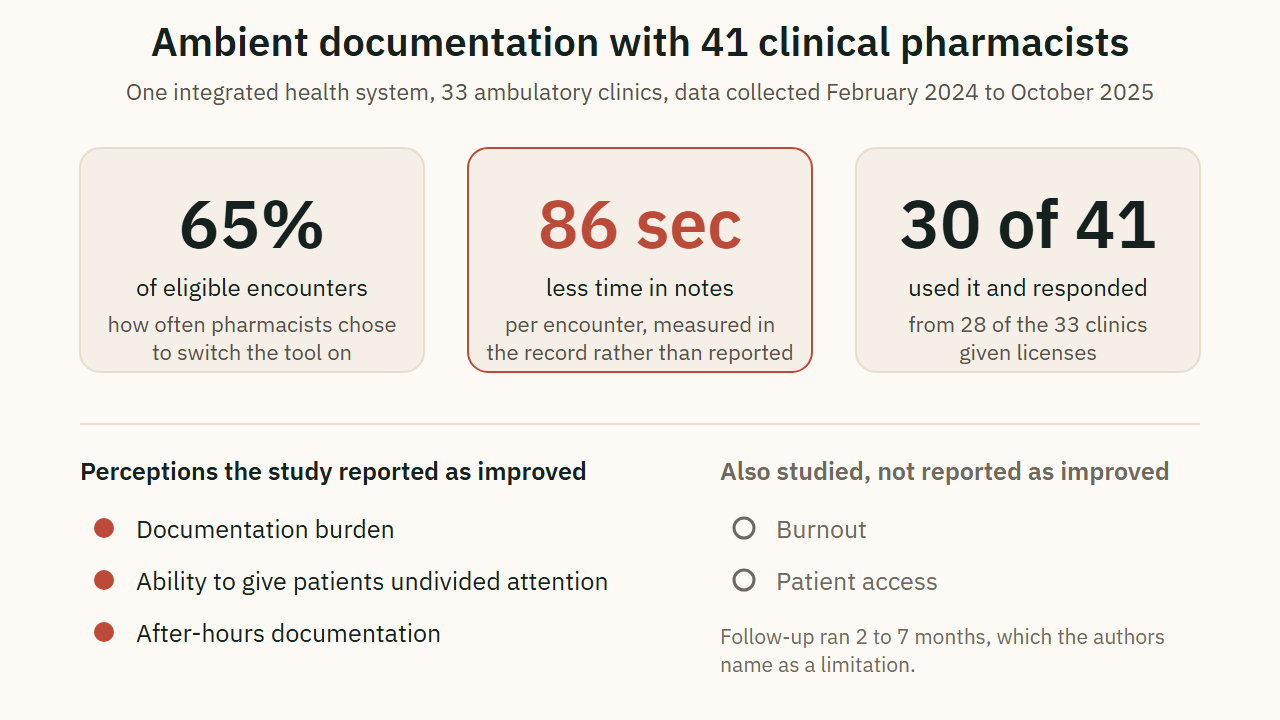
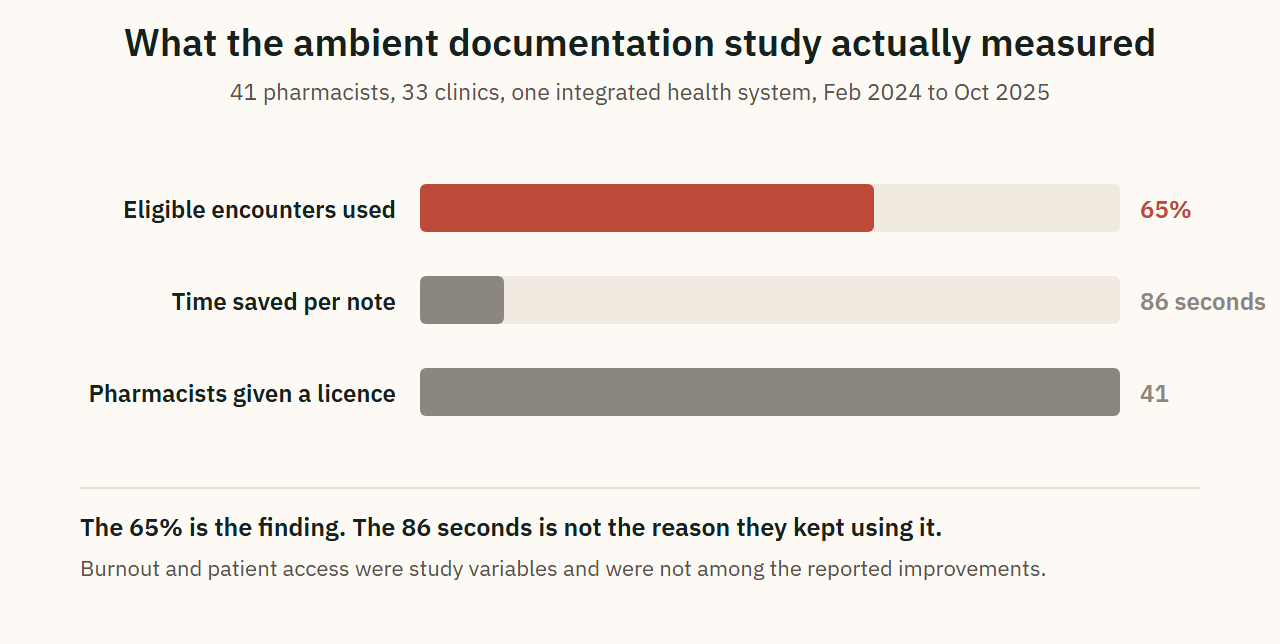
In pharmacy informatics, we often over-rotate on "time saved" because it is easily extracted from EHR metadata. However, a mere 1.5-minute reduction in note-writing time, while statistically significant, is rarely enough to drive a 65% voluntary utilization rate. Usually, when a tool offers such a slim margin of efficiency, adoption decays as soon as the novelty wears off.
The study, which followed 41 ambulatory medication therapy disease management pharmacists across 33 clinics (with 30 providing usable response data), suggests that utilization is our "hero metric." The fact that pharmacists chose to switch the tool on for two-thirds of their visits indicates they were receiving a benefit that clock time fails to capture. As the source context highlights:
The "gap" represents the qualitative value of the technology. To an informatics strategist, this proves that we have been measuring the wrong thing.
The Gift of Undivided Attention
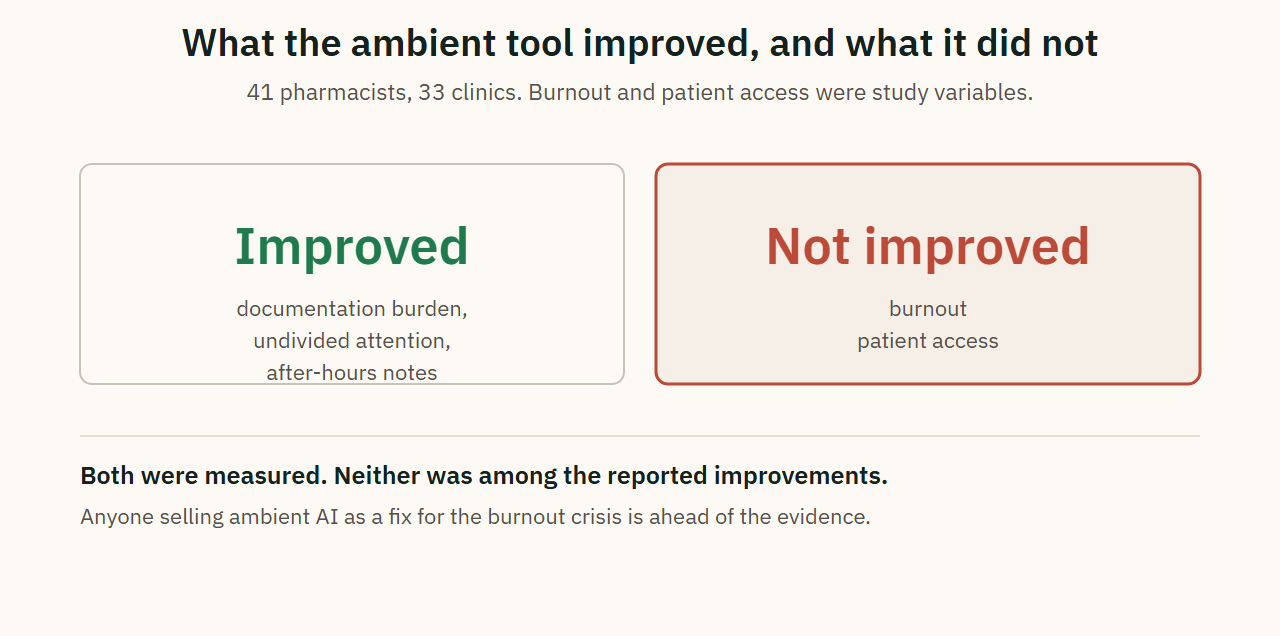
The true value of ambient AI isn't found in the minutes recovered, but in the shift from quantitative time-saving to a qualitative improvement in the care experience. The study found significant improvements in the perception of documentation burden and, crucially, the ability to provide patients with undivided attention.
This changes the "feel" of a clinical encounter. When a pharmacist is no longer tethered to a keyboard, transcribing data while a patient describes their symptoms, the nature of the human connection changes. Furthermore, the study noted improvements in after-hours documentation. For many clinical pharmacists, the true weight of the "documentation debt" isn't the 90 seconds spent during the visit; it is the "pajama time" spent finishing notes at home. Reducing that "homework" is a qualitative win that far outweighs the 86 seconds saved during the clinic day.
The Burnout Reality Check
We must be clear: using ambient AI as a "burnout cure" is currently informatics malpractice.
While the study reported improvements in documentation burden and after-hours work, burnout was not among the reported improvements. Given the gravity of the 8.1 poor mental health days reported by the profession, we cannot afford to misrepresent technology as a panacea for systemic issues.
Ambient AI addresses documentation friction, but it does not resolve the underlying pressures of high patient volumes and clinical complexity. We must manage expectations to protect the credibility of our technology roadmaps. If we sell this tool as a burnout intervention, we will be measured against a promise the evidence suggests we cannot yet keep.
Don't Fly Blind: The 4-Point Measurement Blueprint
Most pharmacy departments will have ambient AI handed down to them as part of a system-wide rollout. Your leverage lies in the measurement plan. Do not rely on "satisfaction surveys" alone. To build a defensible internal case, you must track these four metrics:
Measure Why it belongs in the plan Utilization Rate The single best signal of utility. A rate that decays after month two indicates the tool is failing to meet clinical needs. Time in Notes (EHR Analytics) Provides an objective, benchmarkable figure comparable to the 86-second standard. After-hours Documentation Measures the reduction in "homework" and the true end-of-day workload. Undivided Attention Measure A pre/post survey asking if the pharmacist felt present with the patient. This is where the primary qualitative improvement occurs.
The "First Wave" Warning
In many health systems, pharmacists are included in later deployment waves, following physicians. This creates a significant risk: most ambient AI tools are initially tuned for physician-centric note structures.
Because ambulatory medication management visits differ significantly from standard physician encounters, a tool tuned for a PCP might produce a note that looks like a "failed physician note" rather than a "successful pharmacy note." You must ask your deployment teams:
-
Are pharmacists in the first wave? If not, what is the plan to adapt the AI's "ear" for pharmacy-specific workflows?
-
Who is reviewing the notes? Since the current evidence base does not yet report on note accuracy or hallucination rates, local validation is non-negotiable.
Because the published evidence is currently limited to this single study of 30 pharmacists, your internal pilot is not just a project, it is a significant contribution to the profession's body of knowledge.
Conclusion: The Evidence Opportunity
The 86-second time save is modest, but the restoration of the human connection is profound. We have an opportunity to move beyond anecdotal feedback and collect baseline data before these tools arrive at our facilities. EHR analytics for "time in notes" and "after-hours documentation" are likely already available to you; establish those benchmarks now.
As we integrate these tools, we must ask ourselves: Should we measure the success of our technology by the seconds it saves, or by the quality of the human connection it restores?
Related
- The study preprint on medRxiv
- Will AI replace pharmacists?, on what departments actually use AI for today
- Running the Clinical Program, on evaluating a new tool inside an existing service
- Running the Pharmacy, on measuring a workflow change before you make it