Stop Trying to "Act Extroverted": A Smarter Way to Speak Up When You're the Quiet One

The Hook: The Visibility Trap
If you are a naturally reserved professional, you have likely been on the receiving end of the most pervasive, lazy cliché in management coaching: "You just need to be more visible." This advice suggests that professional impact is a matter of volume and temperament. It frames your career progression as a performance, implying that if you could only be a bit louder or more outgoing, your value would finally be recognized.
The problem is that this advice is a systemic error. It rewards the loudest person in the room regardless of their actual contribution, and it forces reserved professionals into a "visibility trap." When you try to perform a personality that isn't yours, it backfires. Performed extroversion almost always reads as inauthentic. Instead of building credibility, you accidentally introduce a question about your motives; the room starts wondering what you are trying to "sell" or what you want from them.
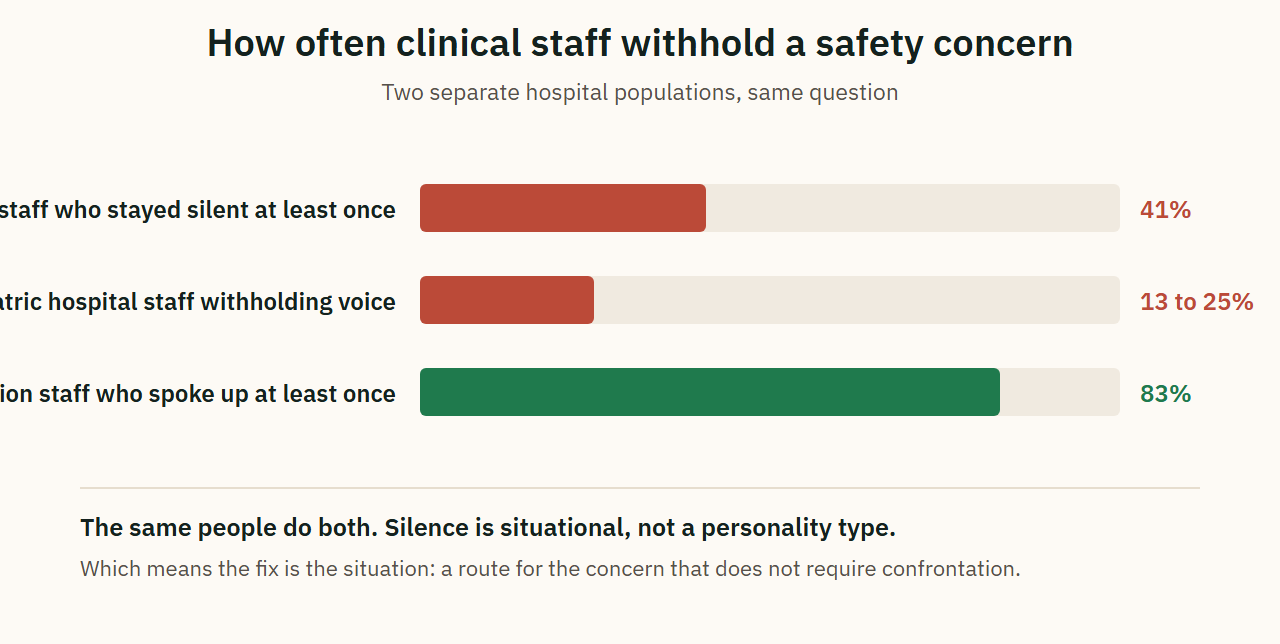
To be effective, we must stop treating visibility as a personality problem. Speaking up is not a fixed trait that you either have or lack, it is a situational professional obligation. By shifting the focus from who you are to what you know, you can discharge your duties effectively without ever having to pretend you are someone else.
Takeaway 1: The Reframe, Visibility is a Professional Duty, Not a Performance
The most effective way to overcome the hurdle of silence is to reframe the act of speaking. When you have a perspective that could improve a process or prevent an error, staying silent is not a personal preference, it is a professional omission.
This shift moves the burden away from "being charming" and places it squarely on "being responsible." You do not need to be a dazzling personality to be a valued team member; you simply need to fulfill your ethical duty to share relevant information.
When you view speaking as a requirement of quality care, it becomes an act of service rather than self-promotion. You are no longer required to speak in every meeting to "be seen." You are only required to speak when you possess information that the rest of the room does not.
Takeaway 2: It's Not Fear, It's Futility
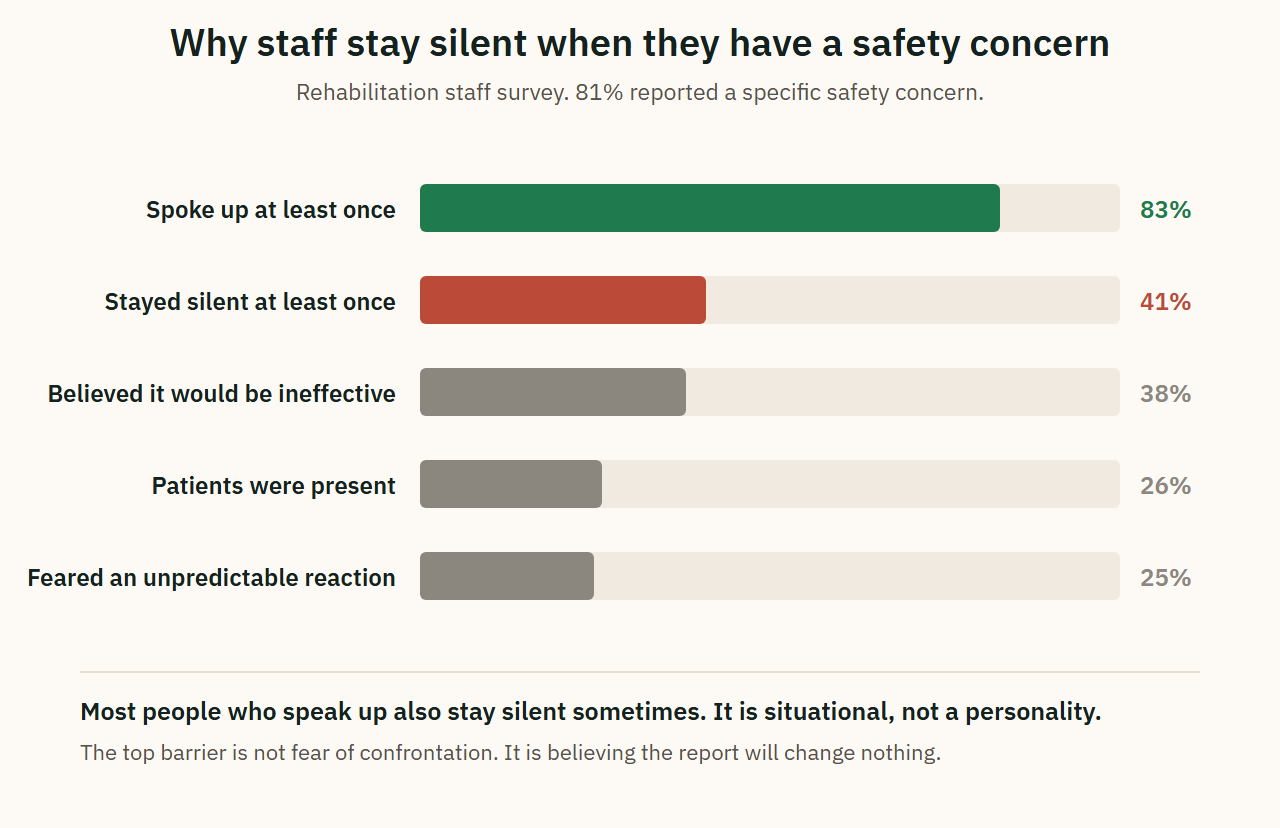
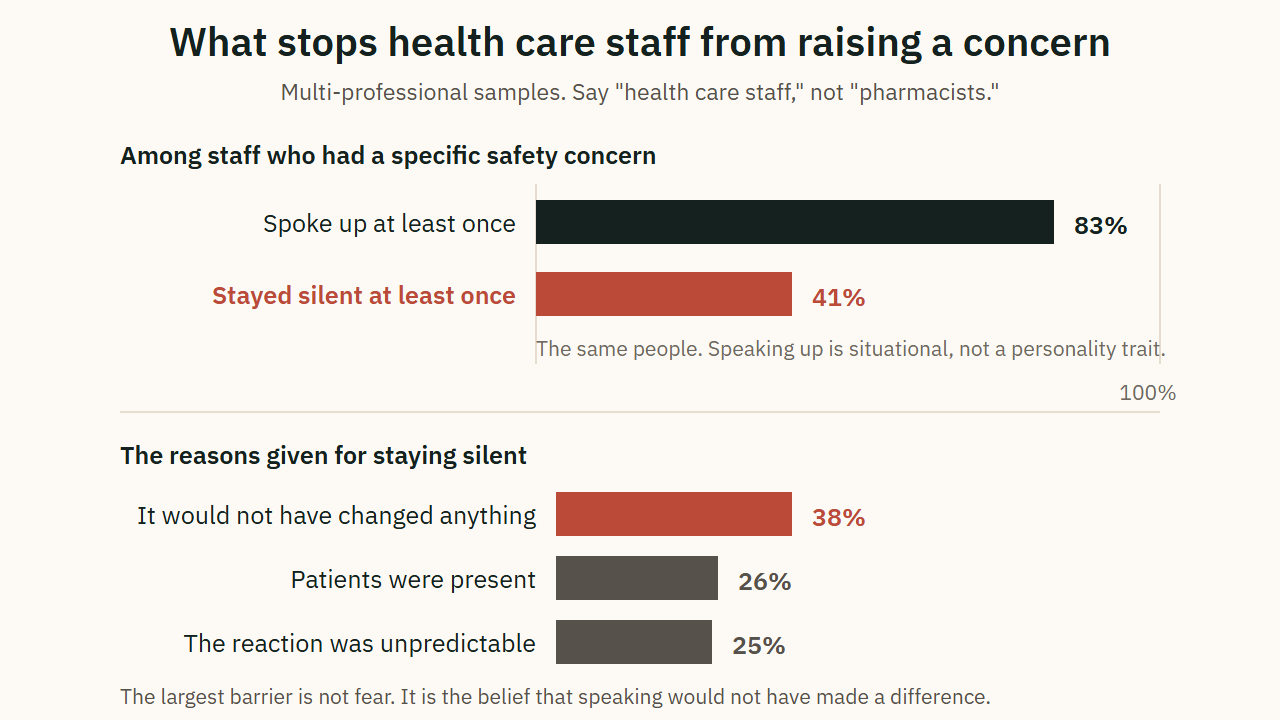
Data from health care staff dismantles the myth that people stay silent because they are "timid." In a study of rehabilitation staff, 81% reported having a specific safety concern. Of those, 83% spoke up at least once, but 41% also stayed silent at least once.
Crucially, these professionals are already using high-level judgment to decide when to speak. For example, willingness to speak up varies sharply by the severity of the issue: 74% to 96% would speak up about a supervisor failing to check a prescription, but only 45% to 81% would do so regarding missed hand disinfection. This proves you are already "calibrating" your voice based on the stakes, not your personality.
When staff do stay silent, the primary barrier is not fear, but a sense of futility.
-
38% believed speaking up would not change anything (futility).
-
26% cited the presence of patients.
-
25% feared an unpredictable reaction.
Futility is a strategist's problem, not a psychological one. If you believe your voice won't matter, don't try to become "braver." Instead, change your tactics: change the venue, bring better data, or use different sentence patterns.
Takeaway 3: The Myth of the Extroverted Leadership Advantage
There is a common assumption that a reserved temperament is a professional handicap, but research suggests that in high-stakes environments, "quiet" leadership is often superior.
A study of 130 pizza franchises found that introverted leaders were associated with approximately 28% higher profits than extroverted leaders, but only when their employees were proactive. When a team is composed of proactive experts (like a clinical team of nurses or technicians), a dominant leader can stifle the group's effectiveness. The reserved leader, by contrast, listens and allows the expert team to function.
This is the "strategist's edge": in a clinical setting, your ability to listen and process information is not a weakness; it is the specific trait that allows a proactive, expert team to excel.
Takeaway 4: The Unit of Visibility is the "Useful Sentence"
You do not need a new personality; you need a better-aimed sentence. In the professional world, reliability compounds faster than presence. A reputation for saying things worth hearing is more durable than a reputation for talking the most. Use these three patterns as tools to bypass the need for charisma:
-
The Specific Observation with Mechanism: Provide data and a cause to move the discussion forward.
-
Example: "The order set defaults to the 1-gram dose, and about a third of the ones I verify get changed by hand afterward. It might be worth revisiting the default."
-
The Honest Not-Knowing with Commitment: Build a reputation for follow-through.
-
Example: "I do not know. I will find out and come back to you by the end of the day."
-
The Question that Surfaces the Problem: Shift the focus from individual failure to systemic failure.
-
Example: "Can I ask how this is supposed to work when the pharmacist is covering both floors?"
This third pattern is a classic strategist's move. It makes a gap visible to the entire room without putting anyone on the defensive, focusing entirely on process over people.
Takeaway 5: Two Tactics for Your Next Meeting
To make speaking up feel manageable, use these two pre-meeting strategies to lower the psychological stakes:
-
Write the one thing down: Deciding whether to speak while simultaneously trying to compose a sentence under pressure is a recipe for silence. Remove the "composition" phase by writing your point down beforehand.
-
Say it early: The psychological cost of speaking rises the longer you wait. A point made in the first ten minutes of a meeting is heard as a contribution. The same point made at minute fifty often sounds like an objection or an attempt to stall the conclusion.
Conclusion: A Shift in Focus
You are not required to change who you are to be successful. You are only required to say the useful thing. The moment you stop performing and start focusing on your professional duty to share information, you build a reputation for high-value judgment.
One thing to do: Before your next department meeting, write down one specific observation with a number attached. Commit to saying that one thing, say it early, and then say nothing else unless the situation requires it. Stop performing; start contributing.
Related
- What actually gets a hospital pharmacist promoted
- How to improve your interviewing
- What does a director of pharmacy actually do?
- Your First Year as a Hospital Pharmacist, on questioning an order without sounding green
- Teaching the Next Pharmacist, on building the same habit in someone else