Your Pharmacy Career Isn't Stalled, Your Goals Are Just Built on the Wrong Foundation

Many pharmacists carry a persistent, nagging feeling that they are lagging behind their peers. Whether you are aiming for a clinical specialist seat, a leadership role, or simply a schedule that doesn't involve every third weekend, the sense of being "stuck" is more than a personal frustration, it is a measurable trend across the profession.
According to the 2024 National Pharmacist Workforce Study, 32.1% of pharmacists feel they are behind where they want to be. This dissatisfaction spikes to nearly 40% for two specific groups: those under the age of 30 and those between the ages of 41 and 50.
The problem isn't a lack of talent or opportunity. Rather, we are using the wrong metrics to measure progress. Is your career actually stalled, or are you defining your success by factors entirely outside of your control?
Stop Chasing Titles, Start Defining Conditions
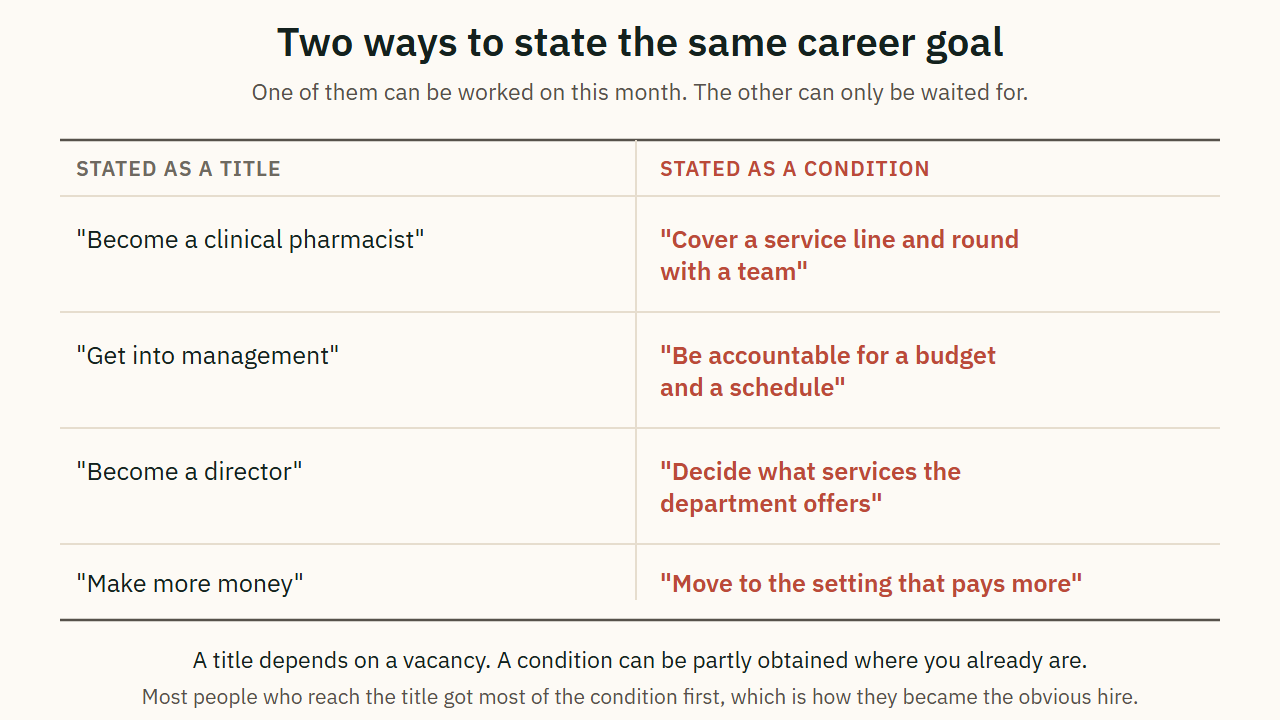
Most pharmacy career goals are framed as job titles. The structural flaw in a title-based goal is that it is 100% dependent on a vacancy. You can be the most qualified candidate in the building, but if your clinical coordinator doesn't retire or relocate, you remain "behind" with no way to move the needle.
To regain control, you must convert "Titles" into "Conditions." A condition is a specific type of work or responsibility that you can often initiate within your current role.
Title-Based Goal (Dependent on Vacancy) Condition-Based Goal (Actionable Today) "Become a Clinical Pharmacist" "Cover a service line and round with a team." "Get into management" "Be accountable for a budget and a schedule." "Become a Director" "Decide what services the department offers."
This shift does more than just reduce frustration; it positions you as the "obvious hire." By building the conditions of your next role today, attending rounds on a specific unit, owning a clinical protocol, or managing a project budget, you are performing the work before you have the title. When a vacancy finally occurs, the hiring panel isn't gambling on your potential; they are simply formalizing a reality you have already established.
The "Shortage" Paradox and the Portability of Skills
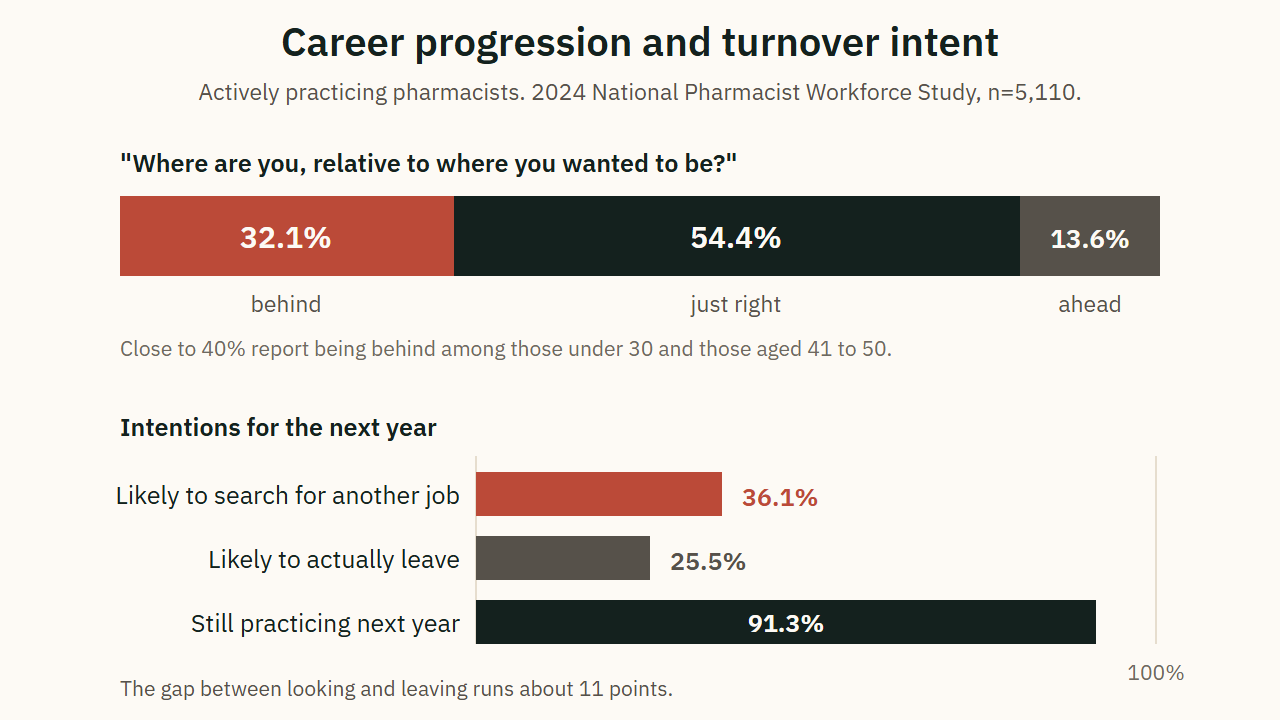
There is a stark disconnect between pharmacists feeling "behind" and the actual state of the market. While many individuals feel stuck in their current seats, the industry is desperate for candidates in the exact roles pharmacists claim to want.
Between 73% and 79% of pharmacy leaders report a severe shortage of candidates for leadership positions. Similarly, approximately 60% of hospital directors report a shortage of clinical specialists and clinical coordinators.
The question is: Why the gap? Part of the answer lies in understanding that opportunity arrives through movement, not just growth. The BLS projects roughly 14,200 openings a year, yet only 1,700 of those are net new positions. The vast majority of openings are "replacement hires." If you are waiting for the profession to expand to find your spot, you are playing a losing game. You must be ready to move when the turnover happens.
Furthermore, you must build "portable" conditions. Data shows that pharmacists are assigned to medical-surgical units in 73.3% of hospitals and critical care in 68.5%. In contrast, oncology (56.9%) and the emergency department (46.5%) are less common. If you build your "conditions" in a widely staffed service line like Med-Surg or Critical Care, your expertise is portable to almost any facility in the country.
Satisfaction is a Valid Destination, Not a Plateau
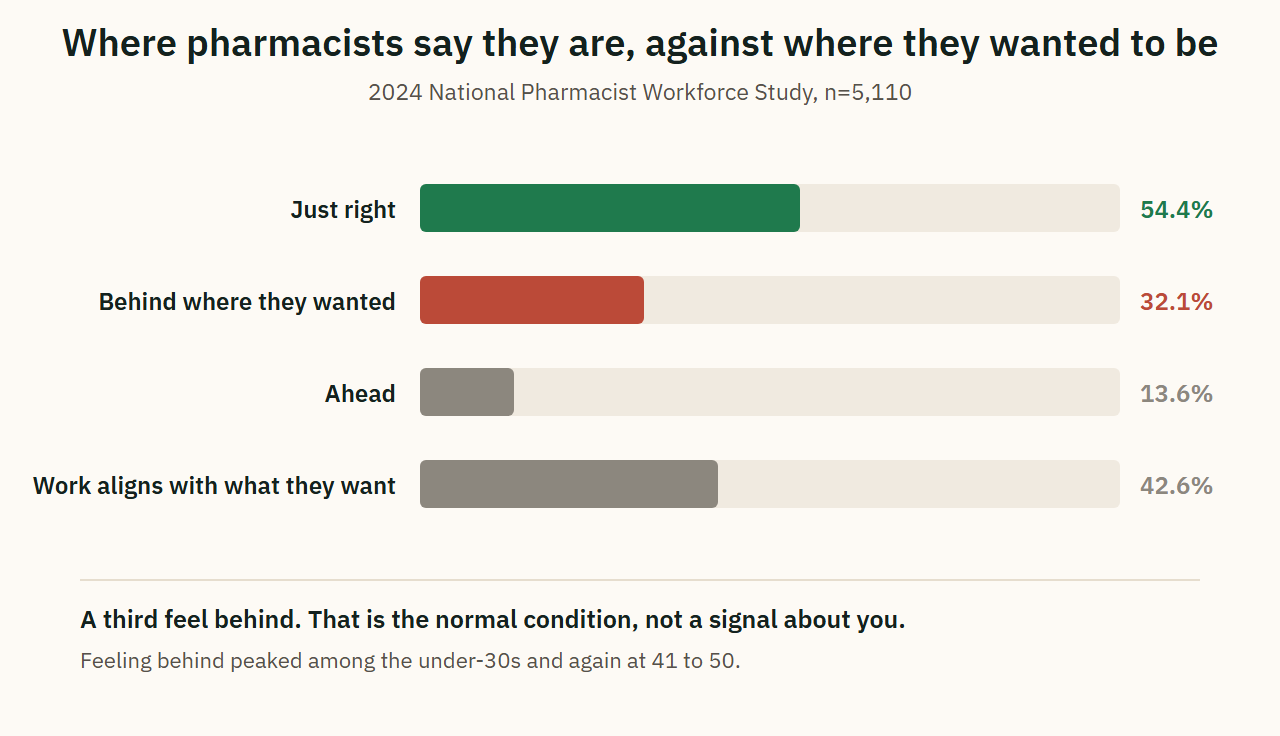
The "career ladder" narrative suggests that if you aren't moving up, you are falling behind. This is a fallacy. The 2024 National Pharmacist Workforce Study found that 54.4% of pharmacists, the majority, say they are exactly where they wanted to be.
We need to stop treating role mastery as a "plateau." Depth in a role and clinical expertise is a legitimate destination. If you find fulfillment in your current scope of practice, you aren't "stalled." You have reached a goal that nearly half of your colleagues are still searching for.
The $44,000 Lever: Setting Over Rank
If your primary goals are driven by compensation or work-life balance, seeking a promotion in your current department is often the least efficient way to get there. Instead, focus on the "Setting."
The May 2025 BLS data shows a baseline average pay of $140,920 for pharmacists, but the spread across settings is massive:
-
Physician Offices: $167,000
-
Hospitals: $151,000
-
Ambulatory Care: $143,000
-
Community Pharmacy: ~$123,000
The $44,000 Lever represents the difference between the top and bottom of this spread. A setting move is almost always a faster path to a significant raise or better hours than waiting years for a management role that might only offer a 5-10% bump. Notably, ambulatory care reports the highest satisfaction levels and the best daytime hours; if your goal is lifestyle-oriented, this is a "setting" fix, not a "rank" fix.
The Content Gap vs. The Rank Gap
Many pharmacists who feel "behind" are actually suffering from a content gap. The workforce study revealed that 42.6% of pharmacists feel their work activities only align with their interests "some of the time."
Too often, we interpret the boredom or misalignment of our daily tasks as a need for "promotion." In reality, we need a change in "content", the actual tasks we perform from 0800 to 1630. You can fix a content gap without a new title by owning a specific clinical metric, a protocol, or a learner.
If your current employer won't let you change the content, refer back to the $44,000 lever: a setting change to Ambulatory Care is often the most direct way to align your daily work with your clinical interests.
Correcting the "Experience" Timeline
We see clinicians stall their own progress by waiting for credentials that were designed to follow, not precede, the work. Here are two critical timeline corrections:
-
Board Certification (BCPS): BCPS requires three years of practice with at least 50% of your time dedicated to pharmacotherapy activities. For many staff pharmacists, the "clock" for certification eligibility only starts once you have successfully integrated clinical conditions into your daily work. The credential follows the role; it rarely unlocks it.
-
Management Readiness: While HR postings often demand five years of "progressive leadership experience," the 73-79% vacancy rate in leadership means those requirements are often flexible. Departments frequently hire candidates who lack the full five years because they cannot afford to leave the role empty. If you have been building "conditions" of leadership (schedules, budgets, projects), you are likely ready now.
Conclusion: The "Tuesday" Test
Advancement in this profession requires a transition from passive waiting to active building. If your career progress depends entirely on a vacancy created by someone else, you don't have a plan, you have a hope.
The Tuesday Exercise To find your true path, perform a diagnostic check on your goals:
-
Write a description of your ideal career goal as a typical Tuesday. What are you doing at 10:00 AM? Who are you talking to? What metrics are you responsible for?
-
Underline the parts of that description that you could start doing this quarter in your current job without a title change.
Whether it is owning a service line, managing a protocol, or taking on a specific learner, start building those conditions on Monday. Are you waiting for a vacancy to open, or are you building the conditions of your next role today?
Related
- Is it ever too late to climb in pharmacy?
- What actually gets a hospital pharmacist promoted
- What does a clinical pharmacist actually do?
- Where pharmacist jobs are being added in 2026
- Running the Pharmacy, on what the roles above staff actually contain